Service Details ·
8 min read
What's Included in Commercial Cleaning?
A straight answer to what commercial cleaning actually covers, what's usually an add-on, and how to read a cleaning scope of work without getting surprised.
You’d think this would be a simple question. You’re paying a company to clean your building, so what do you get?
If you’ve compared two commercial cleaning proposals side by side, you already know. One company’s standard service is another company’s add-on. One quote says “complete cleaning” and means restrooms and trash. Another says the same thing and includes floor care, window sills, and breakroom sanitation. The words are identical. The service isn’t.
Here’s what’s actually standard, what costs extra, and how to tell the difference before you sign anything.
The baseline: what most commercial cleaning covers
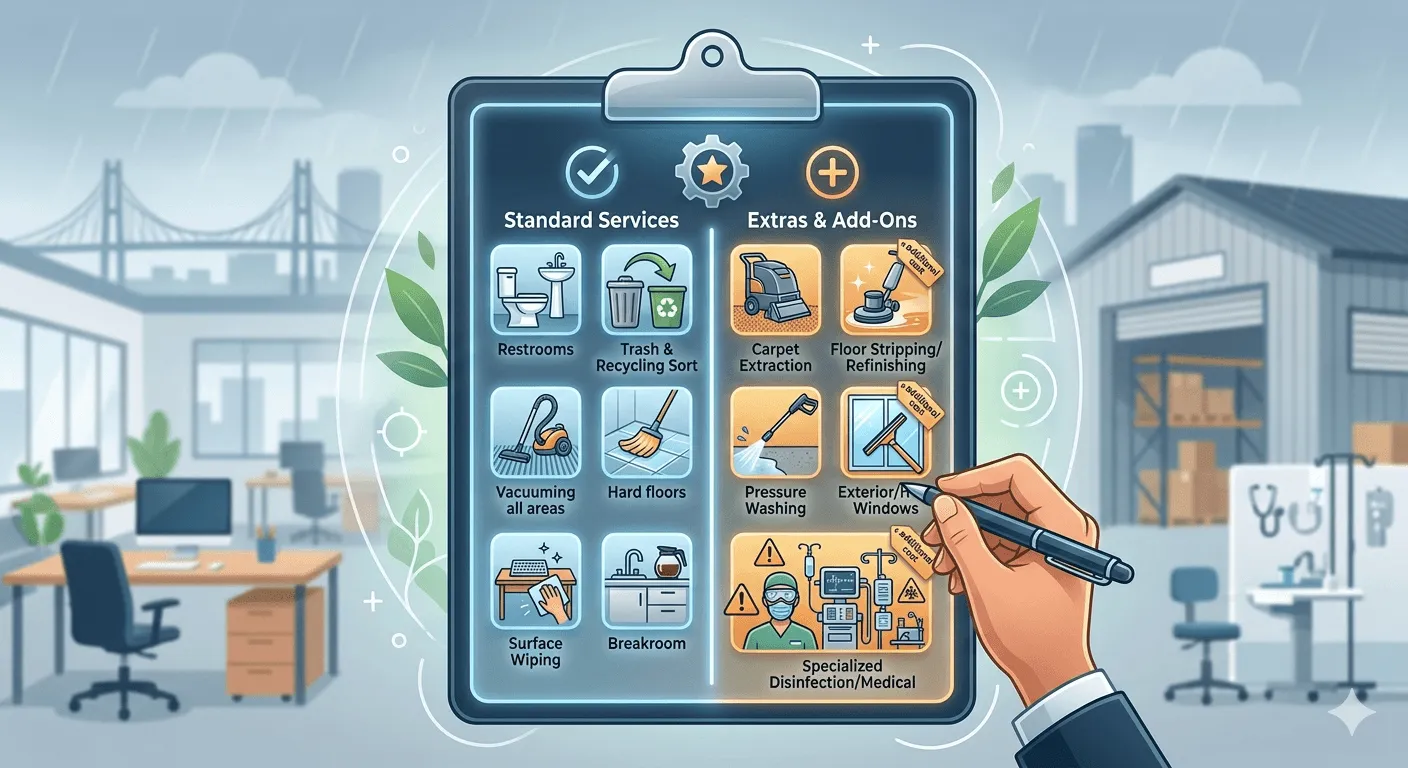
Almost every commercial cleaning company in Portland includes these tasks in a standard recurring contract. If yours doesn’t, that’s worth a conversation.
Trash and recycling. Emptying bins, replacing liners, hauling bags to the dumpster or service area. Portland businesses usually have compost bins too. Not every cleaning company handles the three-stream sort, so ask about that specifically.
Restrooms. Toilets, urinals, sinks, mirrors, counters, restocking paper and soap, floors mopped. This is where cutting corners shows up first and where complaints start. If only one part of your building gets cleaned properly, make it the restrooms.
Vacuuming. All carpeted areas including under desks and along baseboards. That’s how it should work, anyway. A lot of companies vacuum the middle of the room and skip the edges. If your contract just says “vacuuming” without more detail, clarify.
Hard floors. Dust mopping and damp mopping. This is not the same as stripping and waxing, which is a separate, more expensive service. Daily mopping keeps floors clean. Periodic restoration keeps them looking new. Two different jobs, two different price tags.
Surface wiping. Desks, counters, tables, door handles, light switches. This became standard after 2020 and most companies include it now without being asked.
Kitchen and breakroom. Counters, sink, trash. Some companies wipe appliance exteriors. Almost nobody cleans inside microwaves or refrigerators on a regular visit. If you want that done, say so upfront because it won’t be assumed.
Dusting. Shelves, window sills, baseboards, vents. Anything you can reach without a ladder. High dusting (light fixtures, ceiling vents, top of cabinets) is usually periodic or priced separately.
That’s the core. If a proposal doesn’t spell these out, it’s not that they’re automatically included. It’s that you don’t actually know what you’re paying for.
What costs extra
These need different equipment, more time, or specialized training. Expect them quoted separately.
Carpet cleaning. Hot water extraction is the restorative method, the one that actually pulls embedded soil out of the pile. Bonnet and encapsulation are interim methods that hold appearance between extractions, not substitutes for one. Buy them as an “or” and you get a pile that keeps loading. Most offices extract quarterly or twice a year. The Carpet and Rug Institute puts heavy-traffic areas on a quarterly restorative cycle and severe-traffic areas on a monthly one. None of this is part of regular vacuuming and shouldn’t be treated like it is.
Floor stripping, waxing, and refinishing. The restoration work for VCT, LVT, concrete, and similar surfaces. Two operations, two intervals, and proposals mix them up constantly. Scrub and recoat runs two to four times a year depending on foot traffic. A full strip to bare tile and refinish runs every 6 to 12 months. Stripping on the scrub-and-recoat interval floods the floor with high-alkaline stripper far more often than it needs it, which is how tile lifts at the adhesive. This is project work, not maintenance.
Window cleaning. Interior glass might show up quarterly in some contracts. Exterior windows are almost always separate, and anything above ground level gets expensive fast.
Pressure washing. Sidewalks, building exteriors, parking structures, loading docks. In Portland you need this more than you’d expect. Moss and algae colonize everything from October through May.
Post-construction cleanup. Drywall dust, adhesive residue, paint overspray, construction debris. This is specialized. Your regular cleaning crew isn’t equipped for it and shouldn’t be asked to handle it.
Biohazard and mold work. This one isn’t a pricing question, it’s a licensing question, and it’s the item buyers most often try to fold into a janitorial contract. Bloodborne pathogen cleanup falls under OSHA 1910.1030, which requires a written exposure control plan, engineering and work practice controls, a hepatitis B vaccination offer, and training before anyone is assigned to it. Mold remediation in Oregon is contractor work and requires an Oregon CCB license. An unlicensed janitorial company can’t take that job at any price. Ask to see the plan and the license, not a quote.
Pest control. Same category. Oregon requires a commercial pesticide operator license for the business and a licensed commercial applicator for the person doing the work, in the industrial, institutional, health and structural category. A crew setting bait or spraying without it is doing unlicensed pesticide application in your building. Hoarding and gross-filth cleanup carries the same bloodborne pathogen exposure as biohazard and goes to the same kind of specialist.
High dusting and ceiling work. Warehouse rafters, high-bay fixtures, drop ceiling tiles. If it needs a ladder or a lift, OSHA fall protection applies under 29 CFR 1910 Subpart D, and the scope, the training and the insurance all change. For exterior work on a rope descent system, the building owner has to inform the contractor in writing that the anchorages have been identified, tested and certified. That’s your obligation, not theirs, and it’s worth knowing before you ask for a quote.
Specialty restocking. Your cleaning company handles paper towels, toilet paper, and hand soap. But specific soap brands, air fresheners, hand lotion, feminine products? That’s either on you or it’s an add-on.
Building type changes everything
A 5,000-square-foot office and a 5,000-square-foot medical clinic are not the same job even though the square footage matches.
Offices are the most straightforward. The baseline scope above covers most of it. Throw in quarterly carpet cleaning and you’re good. The real variable is headcount and how hard people go on the breakroom.
Medical and dental offices need exam room disinfection protocols, biohazard waste handling, OSHA compliance documentation, instrument staging area cleaning. This is not office cleaning with extra Clorox wipes. It requires specific training and paper trails. If someone quotes you the same rate for a dental office and a regular office, they haven’t thought it through.
Retail means storefront glass, fitting rooms, high-traffic floor care, and display dusting. The timing is different too. Retail usually needs day porter coverage during business hours rather than after-hours crews.
Warehouses need ride-on floor scrubbers, dock cleanup, high dusting in racking areas, and restrooms built for heavier use. The equipment and schedule look nothing like office work.
Multi-tenant buildings split between common areas (lobbies, elevators, stairwells, hallways) and individual tenant suites, usually on different schedules. The property manager has to know who handles what. We have a full guide to common area cleaning if that’s your situation.
Portland-specific considerations
The rain. October through May, everyone walking through your front door is tracking water and mud across your floors. If your cleaning scope doesn’t account for mat rotation, floor protection, and higher mopping frequency in wet months, your floors will look terrible by spring. We get calls in June from businesses scrambling for floor restoration because nobody adjusted the schedule over winter. That’s an expensive lesson to learn once.
“Green cleaning.” Most Portland businesses want eco-friendly products, and most cleaning companies here say they offer them. The question is what “green” means to them. Green Seal certified? EPA Safer Choice listed? Or did they just buy something with a leaf on the label? It’s worth asking the specific question.
Old buildings. Portland has 1920s brick-and-timber warehouses and brand-new LEED-certified towers and everything in between. Older buildings have unusual floor types, worse ventilation, and more dust. A company that mostly cleans suburban office parks may have no idea what your 1960s downtown building needs.
How to read a scope of work
When a cleaning company sends you a proposal, look for four things:
An itemized task list. Every task written out, not “general cleaning.” If they can’t name the tasks, they haven’t thought about your building.
Frequency for each task. Nightly, weekly, monthly, quarterly. “As needed” is not a frequency. It’s a way to avoid committing to anything.
A clear line between what’s included and what’s an add-on. These should be separated, not buried together.
The assumptions behind the quote. How many restrooms? What square footage? How many people in the building? If these numbers are wrong, the scope will drift within a few months.
If the proposal just says “commercial cleaning services, $X/month” with no detail, expect a disagreement within 90 days about what was supposed to happen. It plays out the same way every time: the client thought a task was included, the contractor priced it as an add-on, and there is nothing in writing to settle it.
Our pricing guide breaks down what Portland businesses actually pay by facility type and size, if you want to sanity-check a quote.
How we handle this at RKA
After a walkthrough we send an itemized proposal. Every task listed, every frequency stated, recurring work separated from periodic add-ons. You can read exactly what you’re getting before you agree to anything.
We work with offices, medical and dental practices, retail, warehouses, multi-tenant buildings, and post-construction sites across the Portland metro, including Portland, Beaverton, Hillsboro, Lake Oswego, Tigard, Vancouver, WA, and surrounding communities including Gresham, Tualatin, Wilsonville, Milwaukie, Happy Valley, West Linn, Oregon City, and Troutdale.
Request a quote or call (971) 600-0752.
Frequently asked questions
What is included in basic commercial cleaning? The standard package at most companies covers trash, restrooms, vacuuming, mopping hard floors, wiping surfaces, breakroom cleanup, and dusting you can reach without a ladder. Carpet cleaning, floor refinishing, and window washing are almost always separate.
How often should a commercial space be cleaned? Depends on the space. Offices usually need three to five visits per week. Medical is almost always nightly. Retail tends to split between a day porter and an after-hours crew. Warehouses vary wildly: some need weekly, some biweekly, and most need periodic deep cleans on top of that.
What’s the difference between janitorial service and commercial cleaning? Janitorial is the recurring stuff: nightly vacuuming, restroom service, trash, the routine that keeps a space functional. Commercial cleaning is the broader category that includes both that routine work and the periodic project stuff like carpet extraction, floor refinishing, and deep cleans.
Should I expect my cleaning company to provide supplies? Most bring their own equipment and cleaning products. Restroom supplies (paper, soap) vary by contract. Some companies include them, some don’t. Worth asking before you sign. We go into more detail in our supply inclusion guide.
How do I know if I’m being overcharged? Get two quotes with the same scope. If one is way cheaper, find the line items they cut. Price differences usually come down to scope differences, not generosity. Our Portland rates guide has benchmarks by building type if you want a reference point.
Written by
The RKA Cleaning Team
We're a locally owned team that has been cleaning Portland workspaces since 2020. Our work runs from small offices to large apartment communities, and we write about what we see in the field.
Our Services
How We Can Help
- 01 Commercial Cleaning: One-time and specialty cleans
- 02 Janitorial Services: Recurring night crews and day porters
- 03 Post-Construction Cleaning: Rough and final cleans before move-in
- 04 Industrial & Warehouse Cleaning: Warehouses and plants, including high dusting
- 05 Move-Out & Turnover Cleaning: Apartment and commercial unit turns
Continue Reading
Related Articles
-
Service Details ·
Are Cleaning Supplies Included? The Supplies vs. Consumables Question Nobody Explains
The cleaning company brings their own supplies. Everyone knows that. What nobody explains upfront is consumables (paper towels, soap, trash liners), and who pays for those is where proposals go quiet.
-
Service Details ·
Medical Office Cleaning Scope: Janitorial vs Staff
A medical office cleaning scope tells the janitorial crew what to clean and tells practice staff what stays with them. Use 1 who-cleans-what table, 1 walkthrough table, and the Portland rate range.
Ready to get started?
Let's discuss your cleaning needs
Get a written scope and one flat quote for your Portland building. Recurring work runs month-to-month, or on a 12-month rate lock with a 30-day performance out.