Property Management ·
8 min read
Mold Cleaning for Apartment Turnovers in Portland
A turnover crew can clean surface mold in a vacant Portland apartment. Larger growth needs a remediation contractor. Know the line. Get a free quote.
RKA Cleaning does turnover cleaning for apartment buildings in Portland. The crew cleans surface mold in a vacant unit as part of the turnover. Growth above incidental levels goes to a CCB-licensed restoration contractor experienced in mold remediation. This page shows a property manager where that line sits, what the crew does, and how we set the price.
A mold cleaning apartment turnover Portland managers call about is often 2 jobs with 2 prices. A standard turnover takes 24 to 72 hours. Portland 1-bedroom asking rents ran roughly $1,300 to $1,800 a month across the major rent indexes in mid-2026. A unit that waits 2 weeks for a remediation quote it did not need loses half a month of that.
What the crew cleans and what it must not touch
The rule is 2 sentences long. Surface mold on a hard, non-porous surface in a vacant unit is a cleaning task. Growth above incidental levels, inside a wall, under flooring, or in the HVAC system is a remediation task.
RKA states the limit on 2 live pages. The post-construction page says the crew is not a hazardous materials abatement company, and puts mold above incidental levels outside the crew’s scope. Oregon issues no mold-specific license, so check a contractor’s CCB number and their mold remediation experience instead. The list of what standard commercial cleaning does not cover puts mold remediation outside the scope.
The EPA gives a size guide. Its mold cleanup page says: “If the moldy area is less than about 10 square feet (less than roughly a 3 ft. by 3 ft. patch), in most cases, you can handle the job yourself.” RKA does not set a smaller number in writing. The crew stops at incidental levels.
Use this table to decide who to call first. Copy it with the Copy table button, or click Download CSV.
| What you see | Who handles it | What to do first |
|---|---|---|
| Spots on the tub surround, grout, or caulk line | Turnover crew | Photo it. Put it in the turnover request. |
| Film on window frames or sills | Turnover crew | Photo it. Check the seal. |
| Small dry spots on painted drywall | Turnover crew, if the growth wipes off the paint | Photo it. Measure it. Press the board. If it is soft, or the spot does not lift, the growth is in the gypsum. Stop and call. |
| Spots that come back after 1 clean | Maintenance first, then the crew | Find the water source. |
| Soft or stained drywall, bubbled paint, or a musty smell with no visible spot | Remediation contractor | Stop. Do not disturb it. Call. |
| Growth above incidental levels, or behind a wall, under flooring, or in ductwork | Remediation contractor | Stop. Call. |
| Sewage backup or flood water | Remediation contractor | Water mitigation first. |
Managers ask about mold removal vs mold remediation. The EPA guide for schools and commercial buildings runs a key-steps list. Four of those steps are the line: size the problem, select PPE, select containment equipment, and decide whether the work goes in-house or to a contractor. A turnover crew cleans a surface and reports what it found. It does not build containment. Ask for turnover cleaning when the spot sits on a hard surface. Ask for a remediation contractor when the material behind it is wet.
Where mold shows up in older Portland units
Portland runs 8-plus months of wet weather and about 36 inches of rain a year. On post-construction jobs, the crew checks window frames, under-sink areas, and interior corners for early moisture. The post-construction page says this is where mold starts in Portland’s climate, and that a catch at final clean prevents expensive remediation later. The FAQ page adds mold spores from wet HVAC systems to the list.
RKA adjusts the turnover checklist to the property type. For an older unit, put the same 3 spots on the checklist:
- Window frames and sills.
- The cabinet floor under the kitchen sink and the bathroom sink.
- Interior corners of closets and rooms.
Ask for that check in each turnover cleaning Portland managers order in older units. See the Portland location page for the area the crew covers.
What the crew does in a mold turnover clean, step by step
This is the order the crew works in a vacant unit with surface mold.
- The crew walks the empty unit and photographs every spot before any work starts. Each photo carries a timestamp.
- The crew judges the extent and checks the substrate for moisture. If any spot is above incidental levels, or the board is damp or soft, the crew stops. It calls the property manager the same day and logs the spot as a maintenance issue. The crew does not clean a wet surface.
- The crew puts on PPE per the documented hazard assessment: gloves and eye protection. Respirator work is not part of a turnover clean. A job that calls for a respirator is a job for a remediation contractor, who carries the written respiratory protection program, medical evaluations and fit tests that 29 CFR 1910.134 requires. Read how RKA handles PPE and SDS sheets.
- The crew checks for needles, broken glass and any surface with blood before it bags trash or clears closets. Nobody picks up a suspected sharp or contaminated broken glass by hand, and nobody reaches by hand into a container where a sharp could be. Under 29 CFR 1910.1030(d)(4)(ii), contaminated broken glass comes up by mechanical means, a brush and dust pan or tongs. Anything that looks like a sharp or regulated waste stops the job and gets called in the same day.
- The crew runs the ProTeam HEPA vacuum over the area first. The vacuum captures 99.97% of particles at 0.3 microns, the hardest size to trap. Oregon OSHA says conventional vacuums should not be used, because they transfer contaminant to the air.
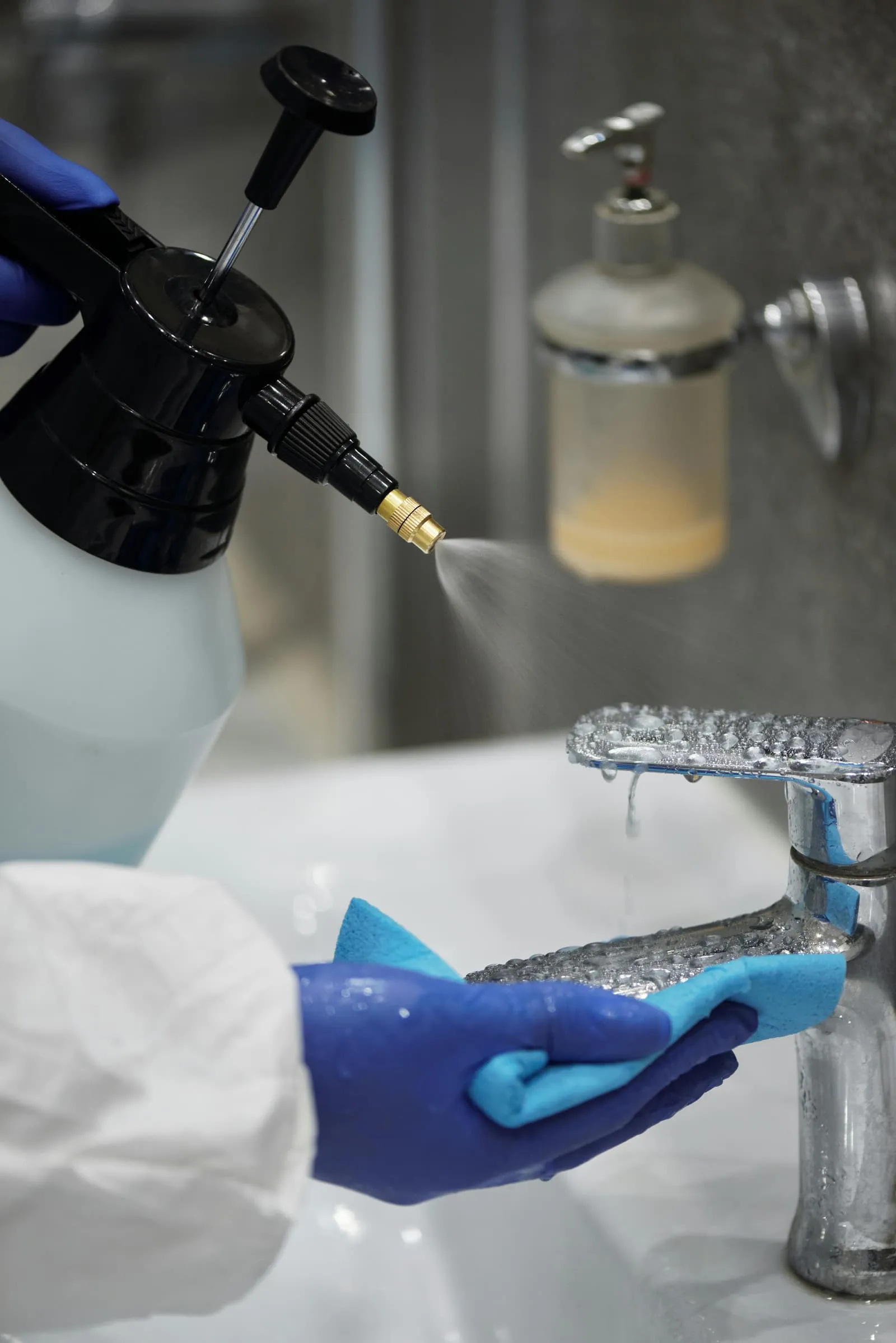
- The crew cleans the surface with a color-coded microfiber cloth for the bathroom zone, lets it dry, then runs a second HEPA pass. That cloth does not go to another zone.
- The crew cleans the rest of the unit per the turnover checklist: kitchen, bathrooms, living areas, floors, windows, vents, and baseboards.
- The crew photographs the same spots after the clean.
- The crew sends the digital checklist and photos to the account manager.
The EPA mold guide says a biocide such as chlorine bleach “is not recommended as a routine practice during mold cleanup.” Killing mold is not the job. Oregon OSHA says you must clean up and remove mold contamination, not just kill it, because dead mold is still allergenic. The crew uses EPA Safer Choice certified products in the unit.
Find the water source or the mold comes back
The crew cleans the surface. Maintenance fixes the cause. The EPA puts it in 2 lines: “Fix plumbing leaks and other water problems as soon as possible. Dry all items completely.”
The crew logs maintenance issues for the property manager. Check 4 common sources first. Check the bath fan for pull. Check the window seal for a leak. Check under each sink for a drip. Check the fridge drain pan for standing water.
Fix the source before the next tenant moves in. Portland gives you 8-plus months of wet weather to test the repair. A second clean of the same spot is a sign that the source is still there. Put the repair on the work order for the unit, not on the next turnover request.
Document it for the deposit and the next tenant
The question managers type, is a landlord responsible for mold in Oregon, has no 1-line answer in the statute. ORS 90.320 does not name mold. It lists what makes a unit unhabitable, and 3 items apply here. The unit must have “effective waterproofing and weather protection of roof and exterior walls, including windows and doors”. The statute requires floors, walls and ceilings “in good repair”. It requires the same for ventilation the landlord supplies. ORS 90.368 excludes mold from the tenant’s $300 repair-and-deduct remedy, so a tenant cannot fix mold and bill you. That is a limit on the tenant, not a pass for the landlord. Read the guide to ORS 90.320 and the landlord’s duty for common areas.
ORS 90.300(12) gives the landlord 31 days after the tenancy terminates and the tenant delivers possession, whichever comes later, to send a written accounting for any claim on the deposit. This page does not say whether you can charge a tenant for mold. The before-and-after photos and the checklist are the record you need either way. The scope table in the bid request post has a turnover line.
What you get after each turnover
Every RKA turnover runs under the CleanAssure Standard: a dedicated crew, documented SOPs, digital quality reporting, and a satisfaction guarantee with same-day or next-business-day response.
After each turnover, the account manager receives:
- Completion photos of the unit.
- A digital checklist with each task marked done, and timestamped photos of each mold spot before and after the clean.
- A maintenance log with each spot the crew found and its photo.
If a spot fails your inspection, tell RKA. You get a same-day or next-business-day response, and the crew re-cleans the spot at no charge.
How we price a mold turnover and what changes it
RKA gives no price over the phone. RKA walks the unit first, about 20 minutes, then sends a written quote. The quote includes labor, supplies, equipment, and insurance. There are no hidden fees. There are no introductory rates that rise later.
3 items set the number:
- Unit size. The quote starts from the square footage.
- Building type. An apartment building and an office get different scopes.
- Turnover frequency. Managers with regular turnover volume get volume pricing.
Same-day or next-day emergency response is available for move-out cleaning. The Portland cleaning rates guide lists $35-$85/hr per technician. It does not give a turnover price. Book the walkthrough on the contact page.
Why Portland property managers send turnovers to RKA
RKA services 148 multifamily units across its Portland portfolio. RKA is owner-operated, woman-owned, and in business since 2020. RKA carries $1 million per occurrence and $2 million aggregate in general liability, is bonded, and sends a COI on request. RKA background-checks and SSN-verifies every staff member. RKA carries workers’ compensation in Oregon and Washington. Read more on proof of insurance.
A standard turnover takes 24 to 72 hours. Move-out cleaning has same-day or next-day emergency response. ProTeam HEPA vacuums run on every account. RKA holds a 5.0 rating on Google.
RKA is not a remediation company. When the crew finds growth above incidental levels, it stops and tells you the same day. See janitorial services in Portland for the rest of the portfolio.
FAQ
can a cleaning company clean mold in an apartment
Yes, surface mold on a hard surface in a vacant unit, as part of a turnover clean. Growth above incidental levels needs a CCB-licensed restoration contractor.
when do i need a mold remediation company instead of a cleaner
When the drywall is soft, the smell stays with no visible spot, or the growth sits behind a wall, under flooring, or above incidental levels. The crew stops at that point and does not disturb it.
is a landlord responsible for mold in an oregon rental
ORS 90.320 does not name mold, but it requires effective waterproofing and weather protection, and ventilation in good repair. Keep before-and-after photos of every turnover.
does bleach kill mold on walls
Bleach can kill mold, but killing it is not the job. Oregon OSHA says you must remove the contamination, not just kill it, because dead mold is still allergenic, and that biocides are not a substitute for thorough cleaning. The EPA does not recommend bleach as a routine practice for mold cleanup. Never mix bleach with ammonia or an acid cleaner; that mix gives off chloramine and chlorine gas. RKA runs a ProTeam HEPA vacuum pass first, then removes the growth with a color-coded microfiber cloth.
Send us the unit address and photos of the spots. RKA walks the unit first and sends a written quote for the mold cleaning apartment turnover Portland managers need done in 24 to 72 hours. Get a free quote, call (971) 600-0752, or email info@rkacleaning.com.
Written by
The RKA Cleaning Team
We're a locally owned team that has been cleaning Portland workspaces since 2020. Our work runs from small offices to large apartment communities, and we write about what we see in the field.
Our Services
How We Can Help
- 01 Commercial Cleaning: One-time and specialty cleans
- 02 Janitorial Services: Recurring night crews and day porters
- 03 Post-Construction Cleaning: Rough and final cleans before move-in
- 04 Industrial & Warehouse Cleaning: Warehouses and plants, including high dusting
- 05 Move-Out & Turnover Cleaning: Apartment and commercial unit turns
Continue Reading
Related Articles
-
Property Management ·
The Real Cost of Poor Common Area Cleaning for Portland Property Managers
One vacancy in a 44-unit Portland building costs more per month than a full janitorial contract. Common area cleaning isn't a maintenance expense. It's a revenue protection decision.
-
Property Management ·
Janitorial Bid Request Portland: Get 3 Equal Bids
3 bids come back with 3 prices for 3 different jobs because the requests went out different. Use 1 scope table, 4 questions, and 1 comparison sheet.
-
Property Management ·
Wet Lobby Floor Cleaning Portland: October to May
Portland entry mats are saturated by 9:30 AM from October through May. This page gives property managers the visit in step order, 1 copy-and-paste lobby floor schedule, and the September strip and wax window.
Ready to get started?
Let's discuss your cleaning needs
Get a written scope and one flat quote for your Portland building. Recurring work runs month-to-month, or on a 12-month rate lock with a 30-day performance out.